A conical spring is a cone-shaped compression spring variant that is highly effective for narrow machinery areas due to its space-saving capabilities and ability to withstand loads without buckling. Through our principal Tokai Spring, PT Niitaka provides custom spring services with giant production capacities: accommodating material diameters up to 90 mm, outer diameters up to 600 mm, and lengths up to 1,200 mm. Utilizing the world’s only 6-Axis “YUKI” machine, shot peening processes to prevent metal fatigue cracking, and transverse load testing machines, we produce high-precision springs that exceed JIS standards. This custom service supports low-volume orders (even 1-2 springs) with guaranteed durability in various temperatures and extreme environments.
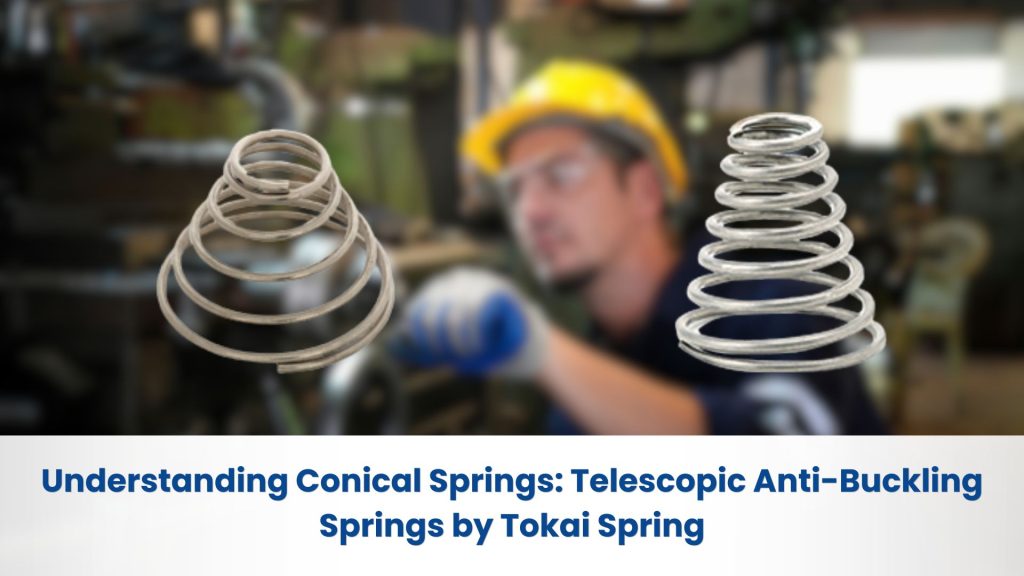
When designing or maintaining industrial machinery, engineers are often faced with a classic problem: the machine requires a strong spring pushing force, but the available space is highly limited. Forcing the use of standard cylindrical springs in narrow areas risks causing the spring to fail quickly or buckle.
To overcome this problem, the engineering world relies on a special spring design known as the Conical Spring. As a specialized variant of the compression spring, which is the most popular type of spring in the world with a simple shape, the conical spring offers unmatched spatial advantages.
Why Choose a Conical Spring?
Unlike straight cylindrical springs, a conical spring has coils that gradually decrease in diameter. This design provides two main mechanical advantages:
- Telescopic Effect (Space Saving): When fully compressed, the smaller wire coils will slip into the larger coils. This results in an incredibly flat spring profile and saves a significant amount of space.
- Anti-Buckling & Stable: Because it has a wide base and can withstand gradual loads (variable rate), this spring is highly stable and does not easily buckle outward when subjected to sudden shock pressure.
Compression Spring: Functions, Applications, and When to Customize
Japanese Standard Custom Spring Production Technology
To guarantee the quality of compression springs in critical applications, PT Niitaka Japindo Makmur collaborates with Tokai Spring, a high-tech spring manufacturer from Japan. We present custom spring manufacturing solutions featuring technological superiority and precise specifications:
1. Giant Dimensional Capacity & Forming Methods
- Small-sized compression springs (including conical types) are formed at room temperature, which is also referred to as cold-formed compression springs.
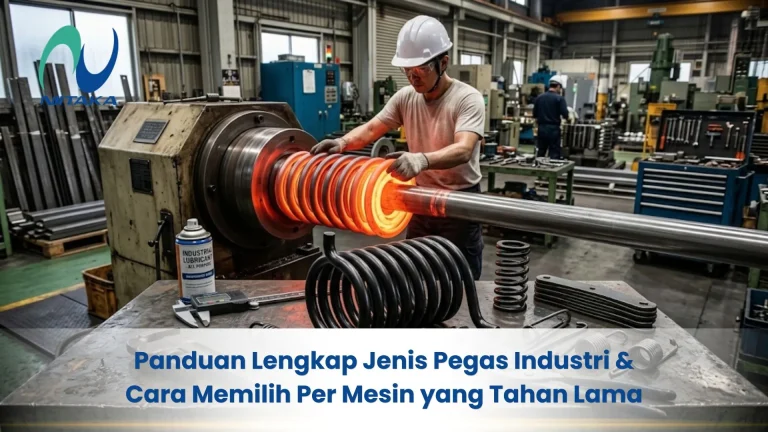
- Meanwhile, larger compression springs are formed by heating the material to a high temperature of at least 800°C (hot-formed).
- These large springs are capable of supporting extreme loads up to tens of tons.
- We can manufacture materials with a diameter of up to 90 mm.
- The outer diameter of the spring coil can be made up to 600 mm.
- The free length of the spring can reach up to 1,200 mm.
2. The Only “YUKI” 6-Axis Machine in the World
- To produce heavy-duty compression springs using large diameter and long materials, we utilize “YUKI”.
- “YUKI” is the only super-large spring coiling machine of its kind anywhere in the world capable of controlling 6 axes simultaneously.
- This machine makes it possible to achieve highly accurate spring characteristics, while also allowing us to support even single spring orders (just 1 piece).
3. Extreme Durability with Shot Peening
- Metal fatigue is the phenomenon of cracks forming in stress-concentrated parts of a material subjected to repeated loads, which ultimately leads to failure.
- To prevent this, our springs undergo a shot peening process, which involves striking the spring surface with round iron balls at high speed.
- This shot peening process significantly improves the fatigue strength of the spring.
4. Load Accuracy Without Lateral Leakage
- When a coil spring is compressed axially, there is always a phenomenon where the load escapes in the lateral (sideways) direction.
- To minimize this phenomenon to zero, we use an in-house developed transverse load test machine to measure and adjust the load.
- As a result, the springs function with the utmost accuracy and precision.
- Overall, the shape precision of our springs exceeds the general JIS tolerance, ensuring that the “bowing” effect is extremely small.
5. Ready for Extreme Environments
- Our complete custom-made and high-mix, low-volume production system is ready to cater to all your environmental requirements.
- We conduct routine verification tests to maintain spring performance in extreme environments, such as temperatures of 100°C or higher, -20°C or lower, and in corrosive atmospheres like seawater or industrial water.
- For standard machine specifications, we frequently use Chrome-Vanadium steel (SUP10) material, which supports indoor working temperatures from -50°C to 180°C.
Order Your Custom Conical Spring Now!
Do not gamble your machinery’s operations with standard components that easily break. We guarantee to deliver the quantity you need, when you need it, at high quality.
Together with PT Niitaka Japindo Makmur and Tokai Spring, let’s design the most precise compression or conical spring for your machine’s load and space. Contact our sales engineering team today for technical consultation on custom spring orders with no minimum quantity!
Frequently Asked Question (FAQ)
Yes. Through Tokai Spring, we implement a “complete custom-made” and “high-mix, low-volume” production system, allowing us to accept and support the design and production of even a single or just 2 springs.
For large springs formed using heating methods above 800°C (hot-formed), we can manufacture springs capable of supporting tens of tons of load. Our maximum dimensional capacity includes material diameters up to 90 mm, coil outer diameters up to 600 mm, and a free length of up to 1,200 mm.
Shot peening is the process of striking the material’s surface with iron balls at high speed. This process aims to significantly improve the fatigue strength of the spring, thereby preventing cracks caused by metal fatigue when the spring receives repeated loads.
When a spring is compressed straight axially, the load often escapes sideways (laterally). Tokai Spring minimizes this phenomenon to zero by using an in-house developed transverse load test machine, ensuring the spring functions with maximum precision and accuracy.