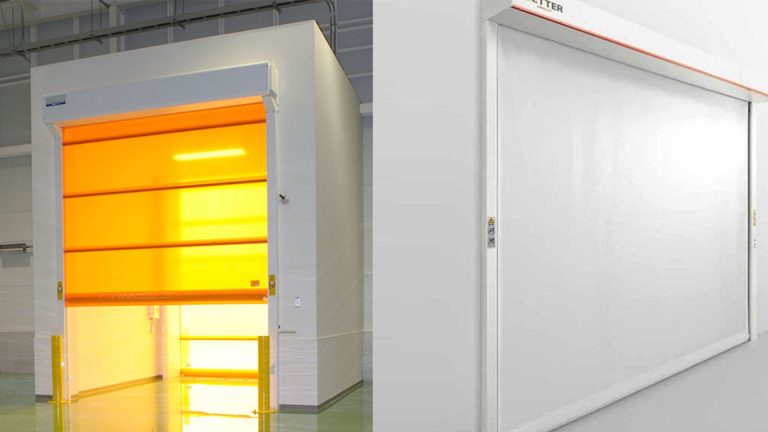
In pharmaceutical facilities, doors operate hundreds to thousands of cycles per day, playing a direct role in maintaining air pressure stability, temperature, and cleanliness standards. A Pharmaceutical High Speed Door, with opening speeds of approximately 1–2 m/sec, is capable of reducing door open time by 70–85 percent compared to conventional doors. Consequently, air exchange and contamination risks can be significantly suppressed.
With flexible PVC material, a self-repairing system, and rapid opening times, the Monban High Speed Door helps lower operational downtime and contributes to cooling energy efficiency by 10–20 percent in air-conditioned areas and cold storage.
In pharmaceutical facilities, doors are often considered passive elements. However, in practice, doors are an active part of the production environment control system. Implementing a specialized Pharmaceutical High Speed Door is now a critical standard in modern drug production.
Every time a door opens, air exchange occurs, pressure changes, and there is a potential for particles to enter from other areas. In an industry working with high hygiene standards (GMP/CPOB), small details like this can have a major impact.
Therefore, the selection of door types for production areas, raw material warehouses, and loading docks cannot be equated with general manufacturing factories. A door system capable of closing quickly and consistently plays a vital role in maintaining a work environment free of dust and insects.
The Real Problem with Conventional Doors
Conventional doors or standard rolling doors generally require a relatively long time to open and close. In field practice, one open-close cycle can take 15–30 seconds, depending on the door’s size and mechanism. If that door is passed through 200 times per shift, the total time the door sits open could reach 50 to 100 minutes per day.
In a pharmaceutical context, this duration is sufficient to:
Disrupt pressure differentials between rooms.
Force HVAC systems to work harder.
Increase the risk of dust and airborne particle ingress.
The problem is not a single event, but a daily accumulation that repeats continuously.
Reducing Air Exposure Time with Speed
A Pharmaceutical High Speed Door is designed specifically to cut this exposure time significantly. With opening and closing speeds generally in the range of 1.0 to 2.0 meters per second, a single door can complete one open-close cycle in just 3–5 seconds.
Compared to conventional doors, this means:
A 70–85% reduction in door open time.
Drastically reduced exposure to air exchange between rooms.
Easier maintenance of pressure and temperature stability.
In facilities with positive or negative pressure zones, a difference of a few seconds per cycle has a direct impact on environmental consistency.
Flexible PVC Material and Downtime Reduction
The Monban High Speed Door uses flexible PVC sheets, not rigid metal panels. Technically, this is not just about safety, but also about operational continuity.
In areas with trolley traffic or light forklifts, minor collisions are almost unavoidable. With conventional doors, collisions often lead to mechanical damage and downtime that can last for hours or even days.
The self-repairing system on Monban allows the door sheet to return to the rails with just one full opening cycle. In practice, this means:
- Operational downtime can be suppressed to near zero.
No need for technician intervention for every minor impact.
Production areas continue running without significant interruption.
Mesh Sheets for Transition Areas
Not all pharmaceutical areas require full air isolation. In transition areas or internal logistics zones, needs often fall between two extremes: air must continue to flow, but contamination must still be limited.
Mesh sheets on Monban are designed for this condition. The net structure allows for natural airflow while maintaining visibility, acting as a physical barrier against dust and insects. This configuration is commonly applied in areas with high ventilation requirements that still reside within a controlled environment.
Measurable Energy Efficiency
In air-conditioned rooms or cold storage, doors are one of the largest sources of energy loss. Using a proper Pharmaceutical High Speed Door helps minimize this loss significantly.
Every time a door opens, cold air escapes and must be replaced by the cooling system. With shorter open times, these doors help reduce the workload of HVAC systems. In factory operational studies, reducing door open time by up to 70 percent can contribute to cooling energy savings in the range of 10–20 percent, depending on room configuration and traffic frequency.
Real-World Applications
In field practice, Monban High Speed Doors are used at various critical points in pharmaceutical facilities, ranging from access between production areas, packaging rooms, and raw material warehouses to loading docks and cold storage. Every location has different needs, whether in terms of opening size, speed, or environmental resistance.
Monban’s approach allows door configurations to be adapted to the function of the room, not the other way around.
Conclusion
In the pharmaceutical industry, door performance cannot be judged solely by shape or material. What determines value is how effectively the door maintains environmental stability under real operational conditions.
With much shorter opening times, safe flexible materials, and a system designed for intensive use, the Monban Pharmaceutical High Speed Door plays a direct role in maintaining hygiene, energy efficiency, and operational smoothness.