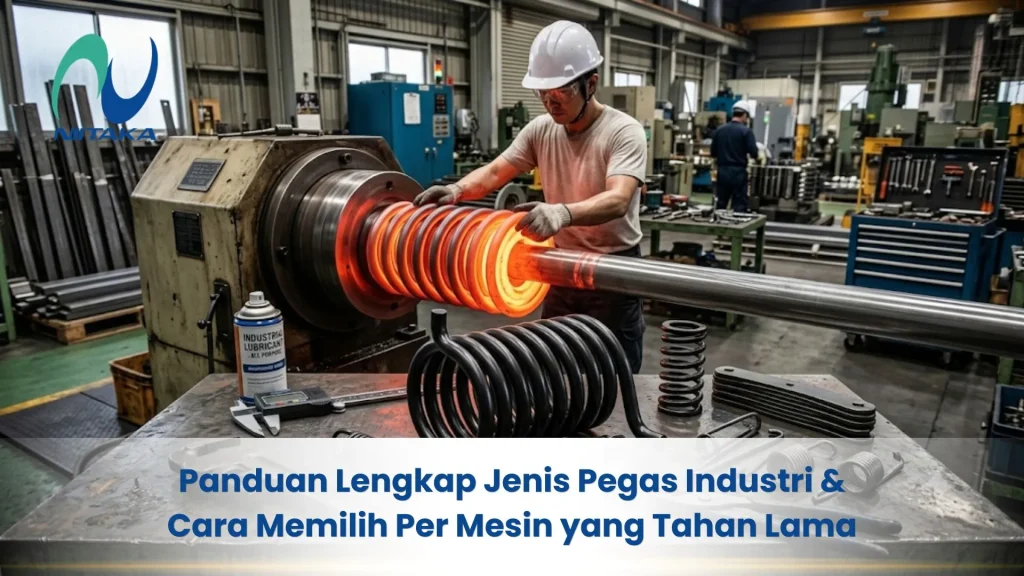
In the world of manufacturing and large-scale production, machine stability is key. Often, costly operational downtime is caused by the failure of one small component: an industrial spring that breaks or loses its durability.
In mechanics, the working principle of a spring always adheres to Hooke’s Law, where the force needed to extend or compress a spring is directly proportional to its extension distance. This guide will dissect the common types of springs used in factories, when you should switch to custom springs, and how to choose the right fabrication service provider.
Table of Contents
3 Main Types of Industrial Springs and Their Applications
Every machine mechanism requires a different mechanical force. Here are the three main categories of industrial springs that must be understood by maintenance teams and engineers:
1. Compression Spring
This is the most common type of spring encountered. Its function is to resist compressive forces; it shortens when a load is applied and returns to its original length when the load is removed. This spring is often applied to engine valves, heavy equipment suspensions, to stamping press machines.
2. Extension Spring
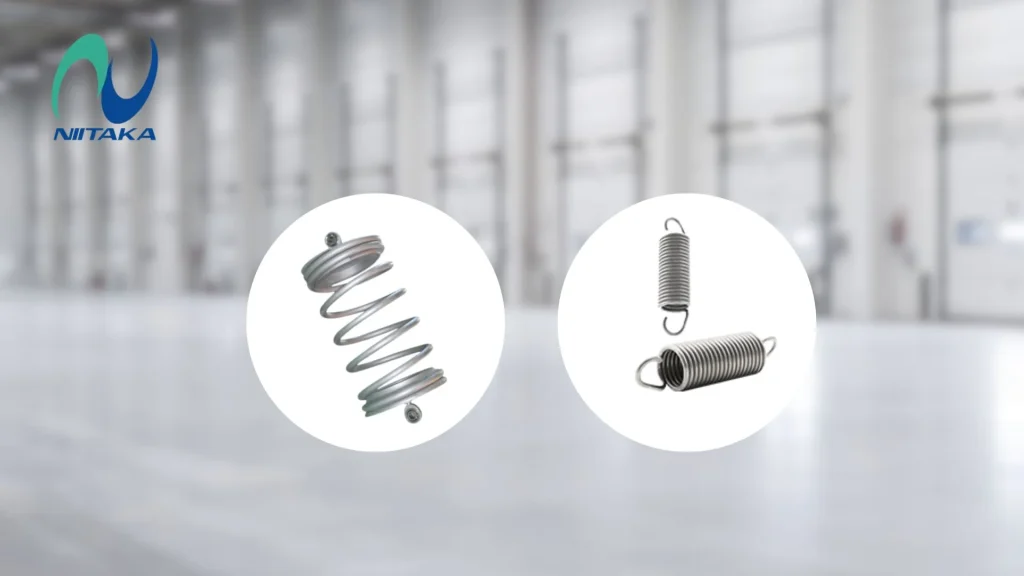
The opposite of a compression spring, an extension spring functions to absorb and store energy when pulled. This spring has a loop or hook at both ends. The most common problem in factory operations is this hook part, which is highly prone to breaking due to excessive load shocks.
3. Torsion Spring
Torsion springs work with rotational force (torque). When the end is twisted, this spring stores mechanical energy to push back to its original position. Its use is highly vital in industrial door hinges, machine levers, and counterbalance mechanisms.
When Should You Use Custom Springs?
Many production facilities spend days looking for spare part springs that fit 100% perfectly in the general market, even though it is often impossible. You must switch from standard springs to springs made by custom spring makers if you face the following conditions:
- Discontinued Machines: The original manufacturer of your machine no longer produces its spare parts. Expert technicians can perform reverse engineering using only the physical sample of your broken spring.
- Fatigue Failure (Frequently Broken): Your machine operates beyond normal limits (heavy-duty). Material fatigue or metal fatigue is the main cause of sudden component failure. This condition requires a redesign and material upgrade.
- Extreme Environmental Conditions: The machine operates in extremely high temperatures or corrosive areas, requiring special high-grade materials (such as Inconel) that are not sold in regular stores.
Choosing a Trusted Custom Spring Maker: The Tokai Spring Standard
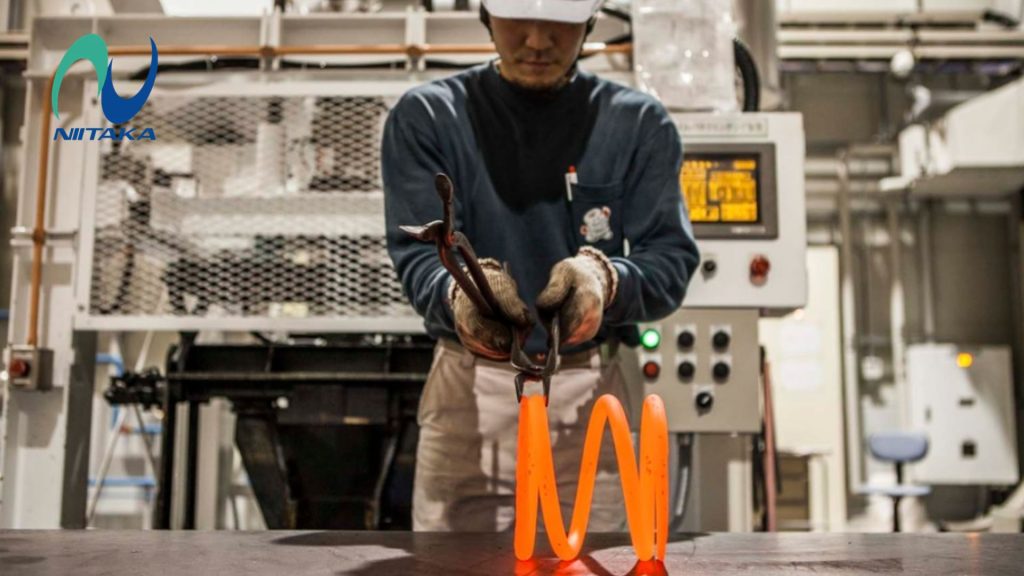
Forming wire into a coil can indeed be done by an ordinary workshop. However, ensuring that every pull and push of the spring has world-class durability and does not damage other machine components requires high-level manufacturing technology.
As a solution to these precision needs, entrust your spring fabrication to a service provider directly supported by the expertise of Tokai Spring Mfg. Co., Ltd Japan. With international standard collaboration, every custom spring produced is guaranteed to prevent recurring downtime in the future.
Conclusion
Choosing a durable machine spring is a crucial investment for the smoothness of your manufacturing production. Recognize the type of mechanical force needed (compression, extension, or torsion), and do not hesitate to collaborate with custom spring experts when standard spare parts are no longer sufficient.
Elevate your industrial machine’s performance. Contact our specialist team today for a direct consultation and get a quote for high-precision spring fabrication!