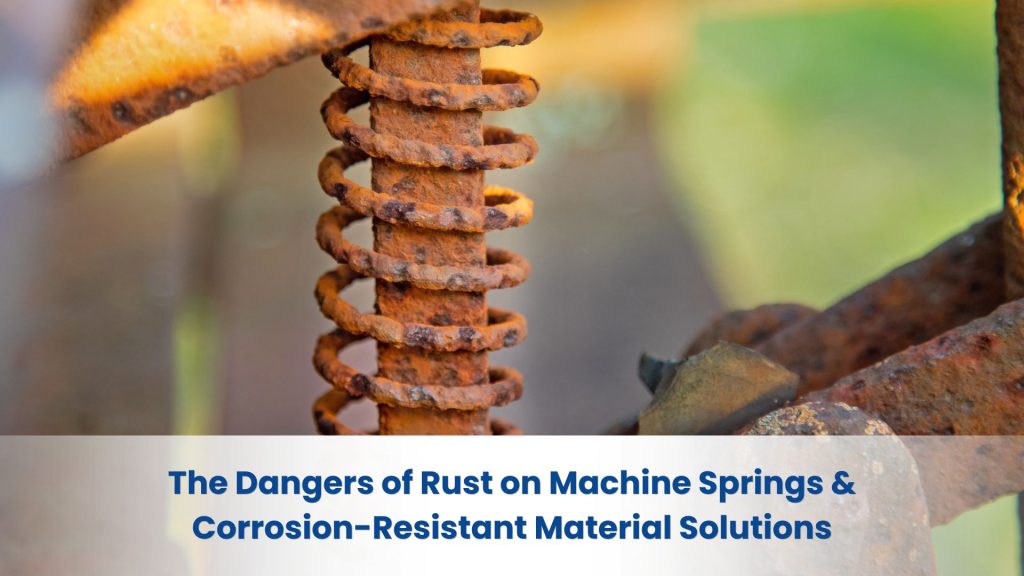
Rust on machine springs is not a cosmetic issue, but a primary cause of sudden spring breakage (Corrosion Fatigue). Rust creates micro-holes that trigger extreme stress concentration when the spring operates. To prevent machine downtime, maintenance teams must switch from regular carbon steel to corrosion-resistant spring materials. Use Stainless Steel (SUS 304 or SUS 316) for wet/humid environments, or use high-end Superalloy materials like Inconel (Inconel 718 / X750) if the spring must operate in areas exposed to harsh chemicals, seawater, or extreme heat above 500°C.
In factory operations, rust (corrosion) is often considered a cosmetic issue that can be solved with a spray of lubricant. However, if this rust attacks dynamic components such as springs, you are facing the threat of a highly fatal machine failure.
Machine springs are designed to be in constant motion—bearing loads, absorbing shocks, and storing energy. When rust begins to erode its material structure, the spring drastically loses its mechanical integrity. For industrial maintenance teams, understanding the dangers of corrosion and choosing the right corrosion-resistant spring material is the key to preventing production line downtime that costs massive losses.
Why is Rust Highly Dangerous for Machine Springs?
1. Stress Concentration (Pitting Corrosion)
Rust does not consume metal evenly. It creates micro-holes (pitting) on the surface of the spring wire. When the spring is compressed or extended repeatedly, these micro-holes act as stress concentrators. As a result, the stress that should be distributed evenly becomes localized in these rusted areas, triggering fine cracks that lead to sudden spring breakage.
2. Material Fatigue (Corrosion Fatigue)
Springs operating in corrosive environments experience a phenomenon called Corrosion Fatigue. Humid or acidic environments will accelerate the material fatigue process (spring fatigue). A spring theoretically designed to last millions of cycles can snap in just a matter of months if its surface is contaminated with rust.
3. The Threat of Hydrogen Embrittlement
Some technicians attempt to prevent rust using electroplating methods (such as Zinc Plating). Unfortunately, an imperfect plating process can introduce hydrogen atoms into the spring steel structure. This turns hard spring steel into a highly brittle material, making it prone to shattering when subjected to shock loads.
Corrosion-Resistant Spring Material Solutions for Industry
Prevention is better than replacing a broken spring every month. The most effective long-term solution is to abandon standard carbon steel (such as SUP10 or Piano Wire) and switch to a base material that is inherently immune to corrosion. Here are the material specifications you must consider:
1. Stainless Steel
This is the most popular and versatile solution for wet environments, washdown areas, or food processing machines. Standard materials like SUS 304 have excellent rust resistance against moisture and water. If your machine is exposed to mild chemicals or coastal environments (moderate salt content), upgrading to SUS 316 (Molybdenum-alloyed) is highly recommended as it is far more immune to pitting corrosion.
2. Superalloys (Inconel X750 & Inconel 718)
If your machine spring has to operate in “hell”—such as inside petrochemical facilities, offshore platforms (submerged in pure seawater), or areas with extreme heat (up to over 500°C)—then Stainless Steel will not survive. You need Inconel. This nickel-chromium alloy is the highest tier for resisting corrosion, high-level oxidation, and does not lose its stiffness even when exposed to extreme temperatures.
3. Copper Alloys (Phosphor Bronze & Beryllium Copper)
For specific applications that not only demand rust resistance but also non-magnetic properties and good electrical conductivity, materials like Phosphor Bronze or Beryllium Copper are frequently used. These materials are immune to water rust and are ideal for industrial electronic instruments or specialized valves.
Order Custom Rust-Resistant Springs at Niitaka
Relying on coated springs is often ineffective because the coating can peel off due to friction and the dynamic movement of the spring itself. Selecting the right base material is the key to a long machine lifespan.
Is your production line frequently halted due to rusted and broken machine springs? Niitaka provides fabrication services for Industrial Custom Springs using specialized materials ranging from SUS 316 Stainless Steel to high-precision Inconel. Contact Niitaka’s engineering experts today, and let’s design spring components capable of enduring even the most extreme environmental conditions!
Contact us by clicking the button below or filling out the form to consult with our experts today.
FAQ
Rust unevenly damages the surface of the spring wire, creating small holes (pitting). These holes become weak points where stress (mechanical load) accumulates. When the spring operates under a load, these weak points trigger small cracks that spread rapidly until the spring snaps in half.
For light machinery, lubricants might help temporarily. However, for heavy industrial machines that are in constant motion, the lubricant layer will quickly wear off due to friction. The best permanent solution is to modify (custom manufacture) the spring using a base material that is inherently immune to corrosion, such as Stainless Steel or Inconel.
You must use an Inconel spring when the machine operates in extremely hot environments (above 300°C to 600°C), or in environments with brutally corrosive levels, such as petrochemical installations, oil refineries, and equipment continuously submerged in seawater. Regular stainless steel will lose its stiffness at such high temperatures.
Yes, SUS 304 is highly resistant to regular water but is still at risk of rusting (pitting corrosion) if continuously exposed to high chlorides (like sea salt). For environments containing salt vapor or harsh cleaning chemicals (washdown areas), SUS 316 material is highly recommended.